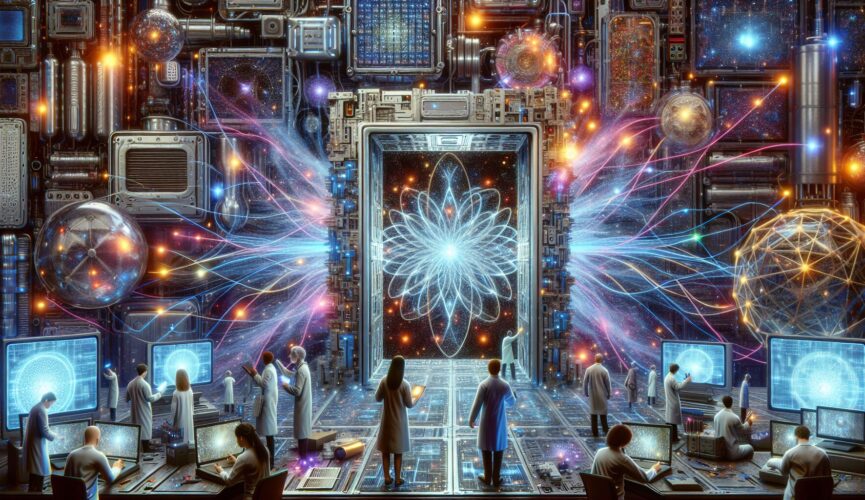
Hey fellow tech enthusiasts! Grab a comfy seat and maybe a cup of your favorite brew – today, we’re diving into the rabbit hole of quantum computing. This isn’t just another tech leap; it’s like leaping off a skyscraper and flying into new computational dimensions. Think of it as the difference between a paper airplane and a stealth bomber; same concept, wildly different execution. I promise I’ll keep the quantum jargon to a minimum and the excitement to a maximum. Let’s decode this quantum quandary!
What’s All the Quantum Fuss About?
First off, let’s get our bearings. Classical computers, like the one you might be reading this on, work with bits – those cute little zeros and ones. Quantum computers, on the other hand, use qubits (get it, quantum bits?). Here’s the kicker: while a classical bit is either a zero or a one, a qubit can be both at once, thanks to the wonders of quantum superposition. It’s like Schrödinger’s cat – it’s alive and dead at the same time until you take a peek!
This ability to exist in multiple states simultaneously gives quantum computers the potential to process unimaginable amounts of data at once. We’re talking computations that would take classical computers millennia could be crunched in mere minutes by their quantum cousins. Mind-blowing, right?
Recent Breakthroughs and Why They Matter
Let’s talk momentum. Quantum computing isn’t just a sci-fi fantasy anymore with the likes of IBM, Google, and a smidgeon of Elon Musk’s charisma thrown in the mix. These titans (and some brilliant startups) have been hitting milestones that have both investors and tech geeks salivating. Google’s Sycamore achieved “quantum supremacy” back in 2019, solving a problem in 200 seconds that would take our best supercomputers 10,000 years. Imagine saying “beat that!” to history’s most powerful computers with just a flick of your quantum chip.
IBM, not to be outdone, has steadily rolled out its own line of quantum processors, increasing qubit counts and lowering error margins. Their roadmap is clear: make quantum computing accessible to the masses, just like cloud service revolutionized storage and computing power. Accessible quantum computers could be game-changers for fields like medicine, logistics, and cryptography, to name a few.
The Good, the Bad, and the Spooky
If this sounds too good to be true, here’s a pinch of reality. Quantum computers are still as flaky as my grandmother’s pie crusts. Keeping qubits in their delicate state requires temperatures colder than outer space and complex error correction algorithms to avoid computation mistakes. We’re essentially straddling realms of science fiction (roots in theory) and palpable reality (hardware engineering).
And then there’s the “spooky” challenge. Einstein didn’t coin the term “spooky action at a distance” for nothing! Quantum entanglement, where particles become interconnected regardless of distance, sounds like a dream for communication, but it’s also an engineering nightmare. We’re still figuring out how and why it works, which makes predicting progress a bit like guessing the weather in London – unpredictable at best.
Daydreaming the Future
Alright, let’s get a bit speculative for fun, shall we? Picture yourself in a future where we solve real-world puzzles with quantum finesse. Curing cancer, optimizing global supply chains, developing perfect climate models – these are no longer moonshot dreams but tantalizingly within reach. The efficiency could be off the charts: energy use could be slashed, problems that stump current computers could be child’s play, and we could forge a more sustainable, healthier planet.
Also, let’s not overlook the creative potential. Quantum-enhanced AI could open doors to unimaginable art forms, music compositions, and maybe even entire virtual worlds crafted by boundless computational creativity. The next Mona Lisa could be crafted with an algorithmic brush instead of a traditional artist’s quills.
Wrapping Up the Quantum Conundrum
To sum it up: we’re standing at the edge of a mind-bending revolution in computing. Quantum might be young, ambitious, and just a tad ethereal, but it’s undeniably electrifying. If we can ride this tech bull successfully, the rewards could be as infinite as the computational possibilities it unlocks.
Until then, consider me your quantum-update buddy – I’ll keep you posted as we continue to unravel and (hopefully) capitalize on the enigmatic marvel of quantum computing. Stay curious, stay enthused, and don’t forget your qubit cheat sheet!
What do you think? Is quantum computing science fiction or inevitable science fact? Drop your thoughts, vibes, or wild speculations in the comments! Let the conversation quantum-entangle us all… 👾